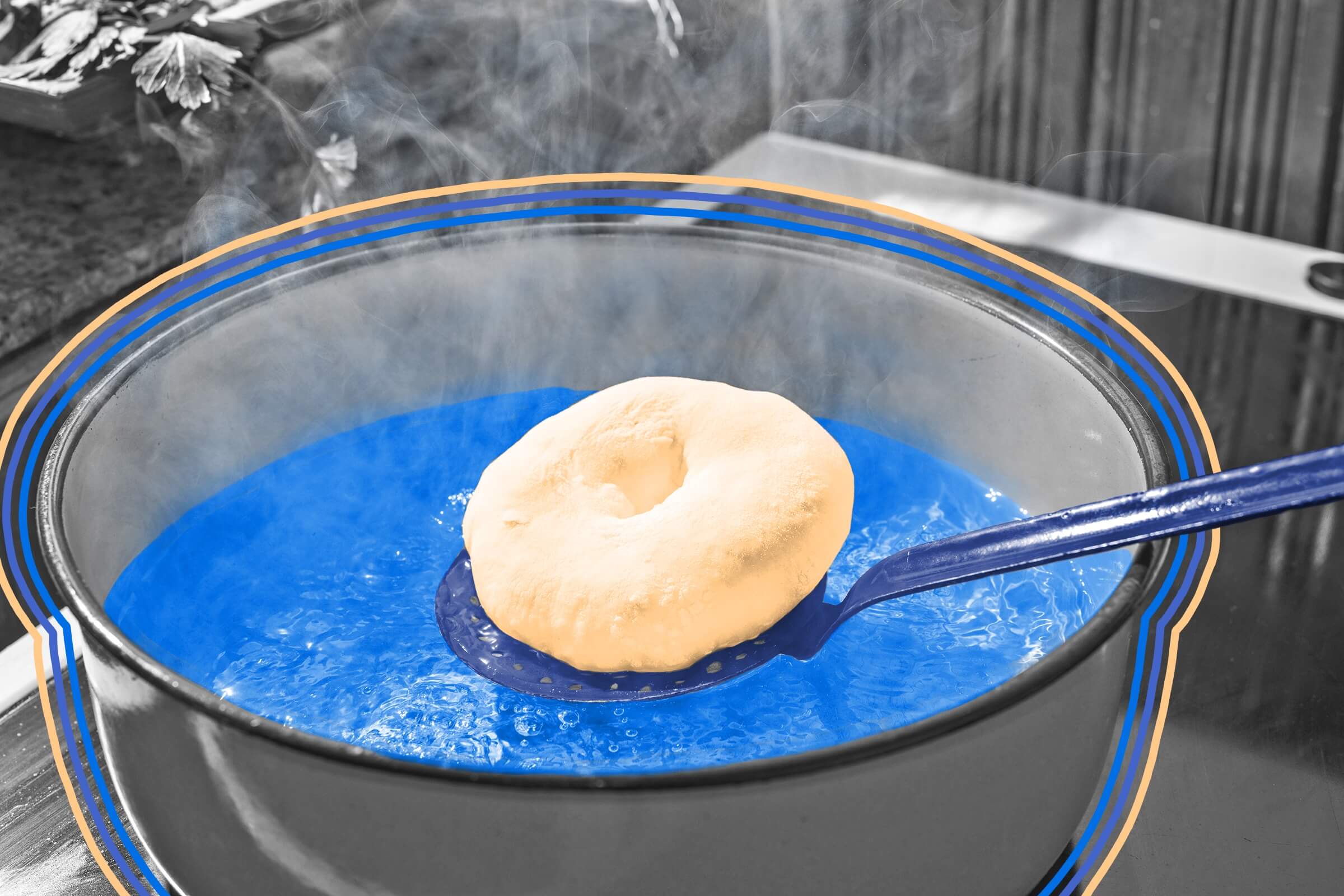
| Whether you prefer yours plain, covered in sesame seeds, or colored like a rainbow, all bagels share one common characteristic: the dough is boiled prior to baking. Boiling is a crucial step that helps gelatinize the dough so it achieves the ideal density; it also partially deactivates the yeast so the bagel doesn't rise quite as high as other bread rolls. During a typical boiling period — about 30 to 60 seconds — bagels also absorb salts, sugars, or other seasonings that are added to the water, thus enhancing the dough's flavor. For these reasons, culinary experts agree that it's inaccurate to refer to bialys or any other unboiled, torus-shaped baked goods as "bagels." Experts trace the origins of boiled bagels to Jewish communities in 13th-century Eastern Europe (specifically modern Poland); the technique was brought to New York City in the 19th century by Jewish immigrants. In 1907, local bakers in NYC formed the International Beigel Bakers Union, which worked to guard the boiling and baking process as a trade secret. The union was successful in doing so until the 1960s, when the invention of a new bagel-making machine helped popularize bagels nationwide. | 





Tidak ada komentar:
Posting Komentar